DeFi on Unicity
Rebuilding the Foundations of Decentralized Finance
The Promise
Satoshi titled the whitepaper
"PEER-TO-PEER ELECTRONIC CASH."
17 YEARS LATER, WE HAVE NEITHER.
Satoshi proposed peer-to-peer electronic cash. The industry built ledgers with decentralization theatre and got co-opted by Wall Street.
Unicity delivers on the original spec: no ledger, no validators, no referees. Just bearer cash, peer-to-peer. The foundation on which we're rebuilding DeFi.
The Industry
EVERY BLOCKCHAIN FROM BITCOIN TO MEGAETH IS THE SAME 17-YEAR-OLD DESIGN.
A shared ledger. A set of validators verifying transactions.
THE TRILEMMA
On a shared ledger every transaction is public, making privacy hard. Using advanced cryptography (FHE, ZK) to recover privacy kills the throughput, and shortcuts that restore throughput give up decentralization. Every design picks two.
The Solution
INTRODUCING
UNICITY
New Foundations
The Foundation of Unicity
TOKENS AS BEARER OBJECTS
an asset you hold, not a ledger entry the network maintains
SELF-CONTAINED
value lives in the object
SELF-PROVING
carries its own proof
PEER-TO-PEER
moves with no ledger lookup
The Execution Layer
EVERY TOKEN IS PROGRAMMABLE.
Each token carries its own spending rule — a predicate — so transfers can be conditional.
A Token
carries its own logic
The Condition
A SPENDING RULE
baked into the token the moment it's issued
The New Owner
who receives and satisfies the predicate
A Few of the Rules You Can Set
SIGNATURE
one key signs
MULTI-SIG
all n keys sign
THRESHOLD
any k-of-n sign
TIME-LOCK
only after τ₀
THE BLOCKCHAIN GENERATES PROOFS OF UNIQUENESS (SINGLE SPEND)
The chain just provides a proof of single-spend — without ever seeing the transaction.
HISTORICALLY, BLOCKCHAINS DID FOUR THINGS.
UNICITY DOES ONE.
The other three happen off-chain, at the edge — by the parties who care.
A Traditional Chain
TRANSACTION VALIDATION
re-executes every transaction
TRANSACTION STORAGE
keeps the full ledger forever
PROVE UNIQUENESS
proves no double-spend
COMMUNICATION CHANNEL
peer-to-peer broadcast network
Unicity
PROVE
UNIQUENESS.
The chain's only job. Everything else is delegated to the holder, the recipient, or any transport.
THE REST CAN BE HANDLED WITH TRADITIONAL TOOLS
Transaction validation, storage and P2P communication all move off-chain.
COMMUNICATION
the asset carries its own proof — the wire just moves bytes
STORAGE
state lives with the owner, not on every node
VALIDATION
the recipient verifies — no validator set in the path
Competition
UNICITY IS THE INEVITABLE ENDPOINT FOR BLOCKCHAIN.
Each generation of consensus removed work from the network. We took the unbundling to its logical conclusion.
2009
BITCOIN
Correctness + global ordering.
Every node certifies every transaction. Every node agrees on order.
2023
SUI / FASTPAY
Correctness only.
Validators certify correctness. Ordering removed.
2026
UNICITY
Uniqueness only.
The network attests one thing: has this token been spent? Correctness moves to the edge.
DON'T TAKE OUR WORD FOR IT —
HERE'S THE MATH
Three formal papers (LLM Friendly). Every claim is proven and public.
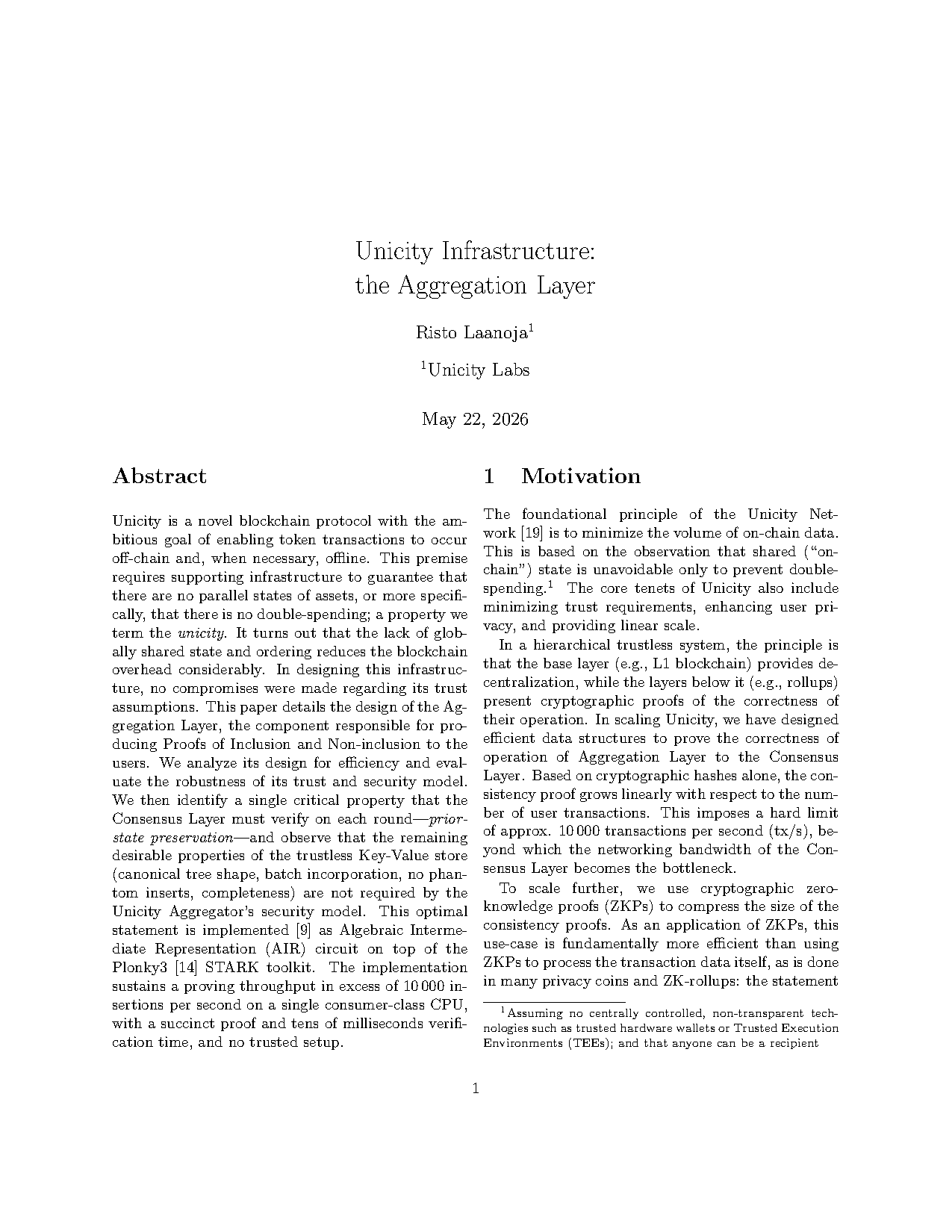
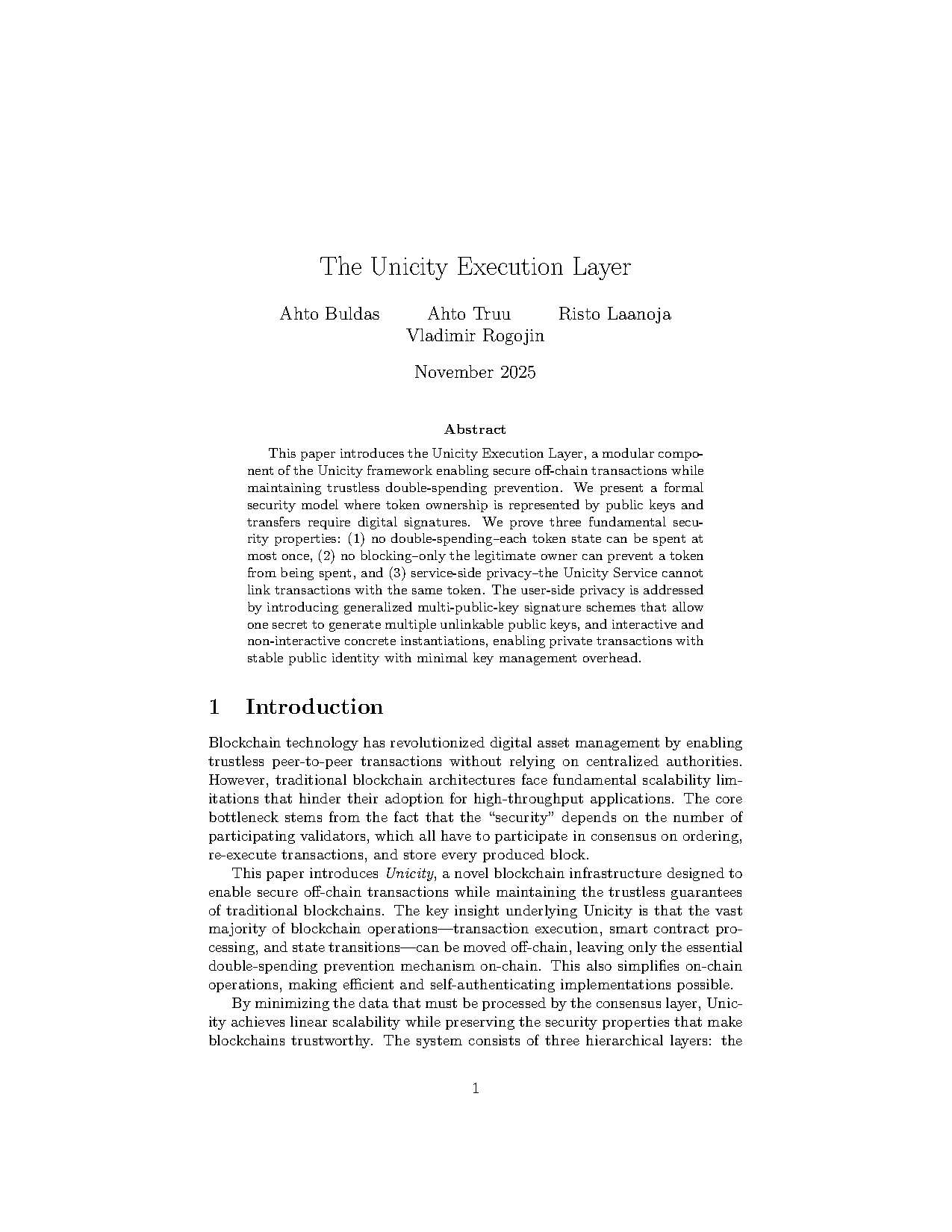
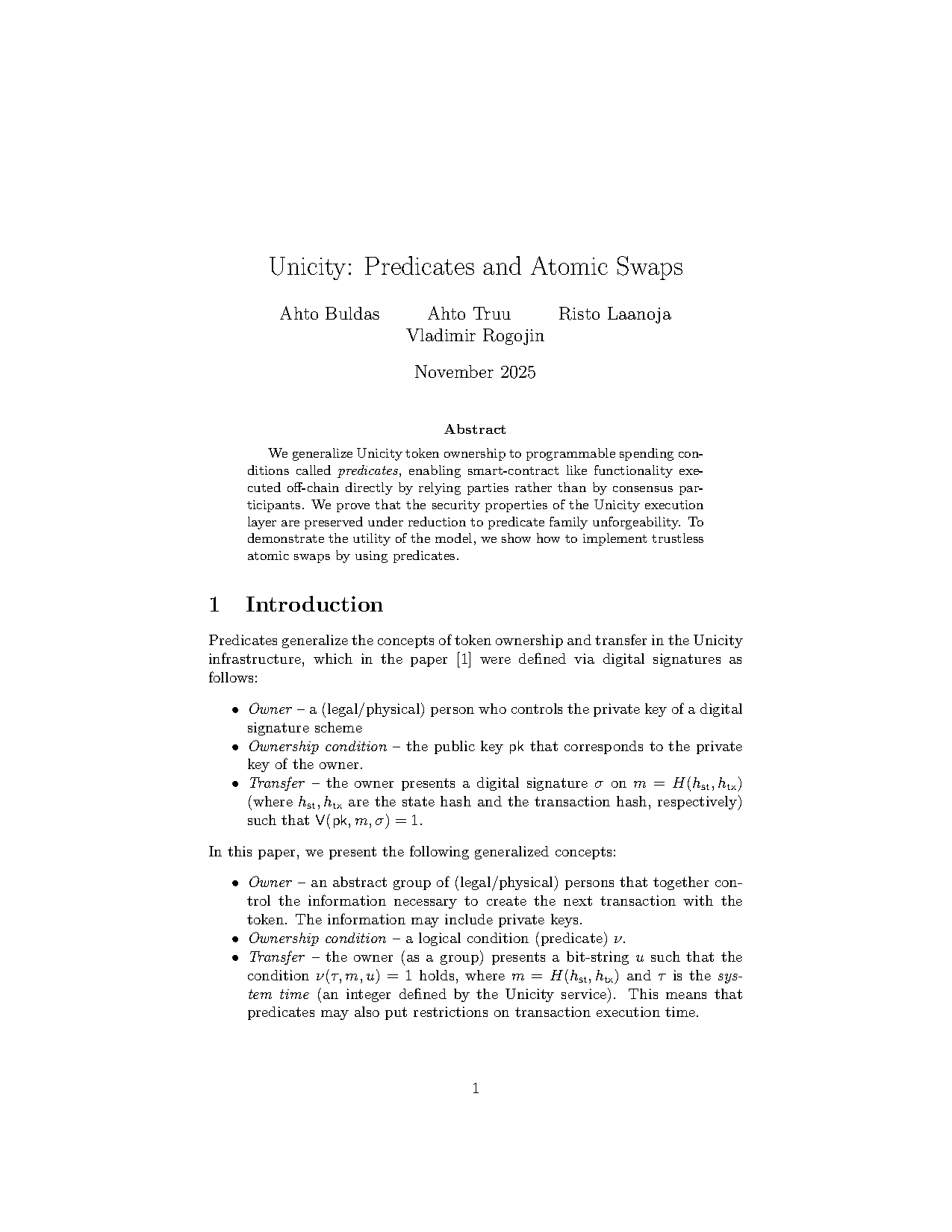
Unicity Network
A BLOCKCHAIN WITH NO TRANSACTIONS
Three layers. The chain certifies uniqueness — and nothing else. Inclusion proofs prove uniqueness of spends (state transitions).
CONSENSUS & EMISSION
decentralized base security
↓ certified state root
UNIQUENESS ORACLE
stores only proofs that token states are unique
↓ inclusion proofs
EXECUTION LAYER
agents and users transact client-side, off-chain
Be Honest
FOUR WINS.
ONE HARD PROBLEM.
Every architecture has a cost. Ours bought us four things — and left us one problem worth solving.
Tradeoff · 01
SPEED
FAST SETTLEMENT, NO BOTTLENECKS
Transactions move directly between parties. No shared validator set, so every spend runs independently of every other.
THROUGHPUT
The chain never validates transactions. Cost per tx collapses; throughput scales horizontally.
Per Shard
on a single consumer-class CPU · Plonky3 AIR + Poseidon2
Sub-cent · Sub-millicent · Sub-microcent
the chain certifies one consistency proof per round — not each transaction
Horizontal Scale
each shard adds another 30K tx/sec · proofs stay succinct
How It Scales
Why it's cheap. The chain never re-executes a transaction — it certifies one prior-state-preservation proof per round: a single SNARK, ~45 ms to verify.
Why it scales. Each shard is independent. No global ordering, no shared validator set, no cross-shard consensus needed.
Tradeoff · 03
PRIVACY
THREE OBSERVERS. NONE CAN LEARN ANYTHING.
Observer 01
THE NETWORK
the Unicity service itself
Sees only opaque commitments — never amounts, parties, or balances.
A request is a hash of a state and a hash of transaction data. The nonce that chains one state to the next is hidden by a perfectly hiding commitment — so the service cannot link two consecutive transactions of the same token.
Observer 02
THE SENDER
the person who paid you
Cannot watch when you later spend what they sent.
Once a token reaches you, the previous owner has no way to compute the registry entry your next spend will create. The next state derives from a secret only you hold. Send it, then they're out.
Observer 03
ANYONE WHO KNOWS YOUR ADDRESS
counterparties, partners, ex-employers
Cannot link two payments to the same recipient — even when both went to you.
You publish one persistent public key. Every sender derives a fresh, indistinguishable transaction key against it. No correlation, no UX overhead, no one-time-address management.
The Cost You custody your own tokens and proofs · lose them, lose the asset
BRIDGES ARE ELIMINATED
A Unicity SOL token — verified straight from Solana. No bridge to trust.
No Bridge · No Custodian · Nothing to Hack
The Hard Part
ONE HARD PROBLEM:
ATOMICITY.
Free in any shared-state model — the database, the global ledger, the world computer all give it by default. Without shared state, "all or nothing" has to be enforced by the tokens themselves.
The Core Operation of DeFi
IN DEFI, THE ATOMIC OPERATION IS THE SWAP
Two assets change hands at once — both legs, or neither.
Unicity has no shared ledger — so atomicity needs a new paradigm.
that's what predicates solve
THE UNICITY TRUSTLESS ATOMIC SWAP
Both parties commit independently — the swap completes, or everyone keeps their token.
Hashed Timelock (HTLC)
THE TIMING TRAP
B late on step 4 — a dropped connection — and A keeps both.
Unicity Predicate Swap
A COMMITS
locks their token
B COMMITS
locks their token
UNICITY SERVICE
the shared reference
AUTOMATIC FAIRNESS
✓ both locked → swap completes
✓ either walked away → both refunded
✓ no deadlines, no chasing, done
Build on Unicity
WHAT CAN YOU
BUILD?
Composable protocols on self-contained tokens.
CEX SPEED. DEX CUSTODY. DARK-POOL PRIVACY.
Binance has the first. Uniswap has the second. Neither has the third. Unicity has all three.
Building on Unicity
AGENTIC DEFI. AN ECONOMY OF MACHINES.
Agents hold tokens, accept predicate-locked payments, and prove execution to release them. No escrow, no broker, no censor, no human in the loop.
THE MATH IS HARDER.
BUT IT'S WORTH IT.
What You Get
A NEW
FINANCIAL SYSTEM.
Massively parallel. Private. Decentralized.
Tokenomics
EMISSION
How new supply enters the network.
Minting Path · 1 of 3 · Token Genesis · Native Currency
NATIVE CURRENCY GENESIS: MINTING OFF-CHAIN
A token is minted by combining three independent cryptographic artifacts — together they make it self-authenticating, verifiable by anyone, forever.
From the Consensus Layer
POW HEADER CHAIN
accumulated work anchors the token
From the Block-Reward Winner
Digital signature
miner authorizes the off-chain mint
Genesis Token
OFF-CHAIN
From the Uniqueness Oracle
Unicity proof
no conflicting version exists
Minting Path · 2 of 3 · Token Genesis · Native Non-Currency Assets
NATIVE TOKENS: OFF-CHAIN MINTING
No PoW, no miner, no external chain. A creator defines the asset and registers its genesis with the Uniqueness Oracle. The token exists.
Genesis transaction
asset type · supply · rules
signed by the creator
Uniqueness Oracle
returns the Unicity proof
no conflicting version
Native Asset
off-chain
Step 1
Step 2
Step 3
No Miner · No Source Chain · Just an Asset and an Oracle
Minting Path · 3 of 3 · Token Genesis · Cross-Chain Assets
MINTING FROM OTHER CHAINS
A Unicity SOL token — verified straight from Solana. No bridge to trust.
No Bridge · No Custodian · Nothing to Hack
Resources
ESSENTIAL RESOURCES
Access all the essential resources to understand, engage with, and contribute to the Unicity project.
Discord: Community Hub
Join our vibrant community for real-time discussions, support, and direct interaction with the Unicity team and fellow enthusiasts.
discord.gg/BGuqUtwZp3Whitepaper: Vision & Strategy
Dive deep into Unicity's foundational vision, innovative technology, and strategic roadmap for the future of digital asset execution.
github.com/.../whitepaper/releases/tag/latestZK Bluepaper: Technical Deep Dive
For developers and technical experts — architecture, protocols, and mechanisms driving Unicity's P2P execution model.
github.com/.../aggr-layer-paper/releases/tag/latestTechnical FAQ
Answers to common technical questions about architecture, agents, scalability, and security. Perfect for developers and stakeholders.
bit.ly/3Mz7TxASecurity Proofs
Formal security proofs and cryptographic analysis of Unicity's protocols. For security researchers and auditors.
github.com/.../execution-model-tex/releases