The Aggregation Layer: Unicity Chief Architect Risto Laanoja

At NGISE 2026, Risto presented the Aggregation Layer, the part that stops double spending without needing to trust the operator.
Blockchain has been stuck on the same tradeoff for years. Put everything onchain and you get global ordering, global execution and storage that only grows. Move it offchain and you open the door to double spending.
In Unicity, a token is a data object its owner keeps, and the recipient verifies its full history offline. What they cannot check offline is whether that exact state was already spent. A copy looks identical to the original.
Risto’s claim: the only thing that needs to stay online is a record of spent states. Zero knowledge proofs don’t replace it, because they prove a transaction is valid, not that it’s the only one.
When a token is spent, the Aggregation Layer records which transaction spent it, and any second attempt is refused. Each round, the aggregator seals the record into one fingerprint and proves to the consensus layer that it only added entries and changed nothing. The recipient then gets a short proof of unicity that they can check themselves.
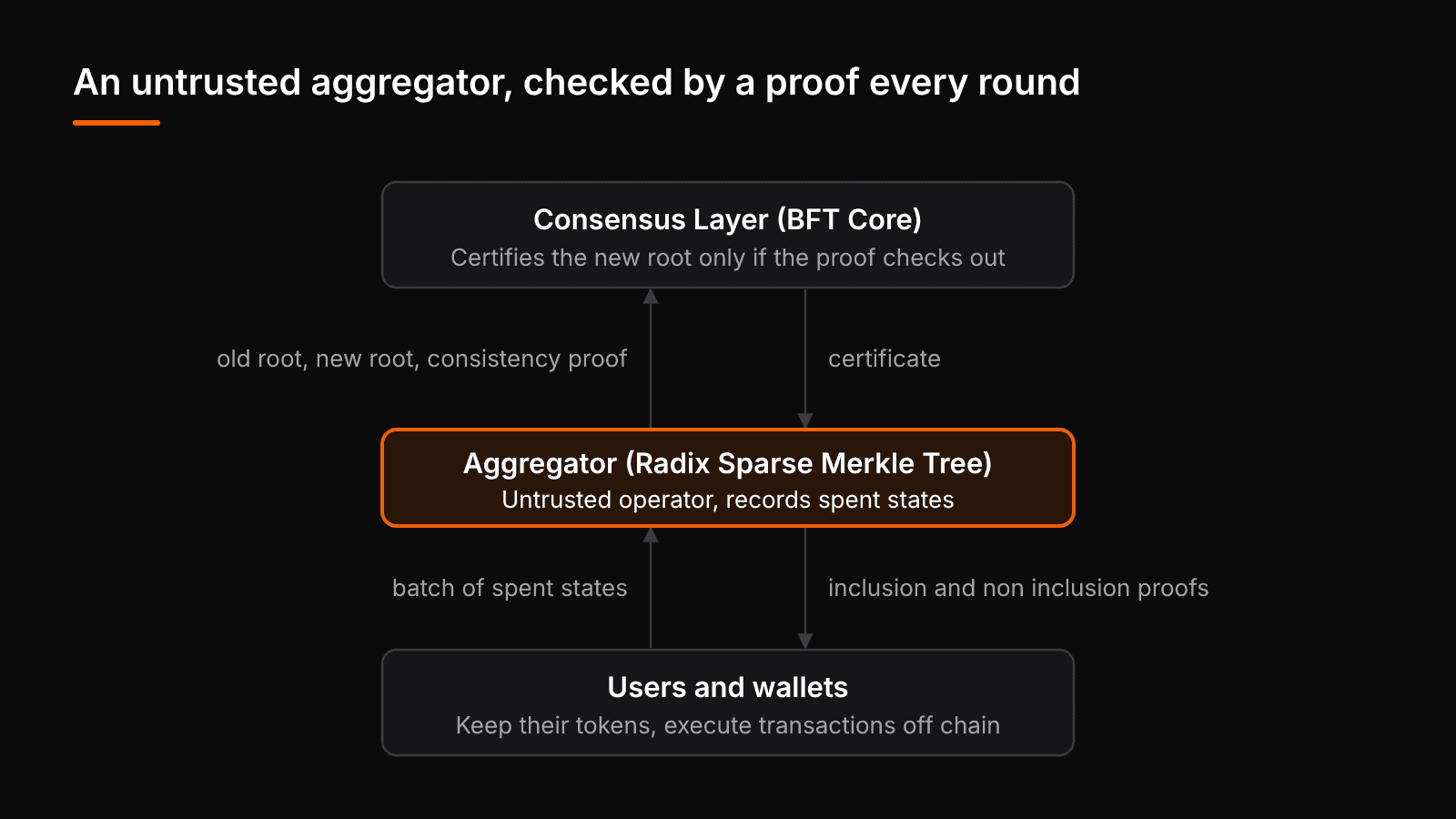
The paper proves the record can’t be rewritten unless someone breaks the underlying hash function. A cheating operator fails verification. The proofs are STARKs with no trusted setup. If an operator refuses to serve someone, users can resubmit through another aggregator in the same shard.
One shard handles more than 10,000 insertions per second on a single CPU, and a round verifies in under 50 milliseconds. The chain checks one proof per shard per round, so its load grows with shards, not transactions.
Rollups still order and execute every transaction through a sequencer. Unicity skips that entirely, and the network only ever stores hashes. This lets stablecoins work like self custodial cash, sent peer to peer with no gas fees, and lets AI agents hold and spend their own credits at machine speed.
Risto spent 30 years in security, heading payment card security at SEB and then 18 years as Security Architect at Guardtime. He wrote the paper with Mike Gault, Guardtime founder and Unicity Labs CEO; Ahto Buldas, Guardtime cofounder and one of the minds behind Estonia’s national ID card; and Dirk Draheim of Tallinn University of Technology.
''We have achieved several firsts in blockchain technology: using zero-knowledge technology to prove 10,000 transactions per second on a single consumer-grade CPU, natural sharding without the usual downsides, and providing formal proofs of doing it correctly—-the subject of our NGISE paper and presentation. All of this is made possible by the minimal on-chain footprint of the Unicity Network.'' - Risto Laanoja
Double spending is the reason every transaction used to go onchain. Unicity’s answer is one provable record of what has been spent. Nothing more is needed.
Unicity Labs builds cryptographic infrastructure for autonomous AI. The Unicity Protocol provides post-quantum, offline-verifiable proofs of uniqueness, time and provenance for data and digital assets; the Unicity Agent Operating System provides a runtime in which AI agents execute under enforced policy with a verifiable record of every action.